

The weeks after a well-timed microneedling session are usually when the compliments start. Skin looks brighter, and foundation sits more smoothly over pores that seemed larger a month earlier. Then a season passes, the glow softens a little, and the same question comes up at almost every follow-up appointment. How often should you come back to keep it?
The answer depends on where you are in treatment. A first series is usually spaced four to six weeks apart so new collagen has time to form between visits, and once that series is complete, most people hold their results with a maintenance session every three to six months. At microneedling in Clarksville, TN, the schedule is built around your skin concern and how your skin responds after the first visit, so the plan you leave with fits both your face and your calendar.
What is microneedling, and why does timing matter?
Microneedling, known clinically as percutaneous collagen induction, is a minimally invasive skin procedure that uses a pen-shaped device fitted with fine, sterile needles to create thousands of controlled micro-channels in the skin. The body reads each channel as a tiny wound and responds with its natural repair process. Growth factors are released into the treated area, and fibroblasts in the dermis respond by laying down fresh collagen and elastin over the weeks that follow. At Face Fabulous Med Spa, treatments are performed with the Rejuvapen device, which allows the needle depth to be adjusted for each area of the face.
Timing matters because that repair process runs on its own clock. Surface redness usually settles within a few days. The deeper work, in which new collagen forms and then slowly matures into organized fibers, continues for weeks and keeps going for months after the skin looks fully healed. A session booked too soon interrupts that work before it finishes, and a session booked too late lets the momentum fade. Good spacing sits between those two points. Our guide to the benefits of microneedling explains what that rebuilt collagen does for tone and texture once it matures.
How often should you do microneedling during your first series?
Most patients begin with a series of three to six sessions spaced four to six weeks apart. The four-week minimum reflects how skin renews itself. The outer layer of the skin turns over roughly once a month in younger adults and more slowly with age, and the early stage of collagen formation needs a similar window before the skin is ready for another round of stimulation.
The length of the series depends on what you are treating. Someone whose main goal is brighter, more even skin often sees what they want after three sessions. Acne scarring and stretch marks usually take longer, often four to six sessions or more, because scar tissue has to be broken up and replaced before the surface starts to look smoother.
A series works because each session builds on the one before it. The collagen triggered by your first appointment is still developing when you return for the second, so the results stack instead of starting over. This is why a patient who books three sessions a month apart usually sees a more noticeable change than one who books a single session and waits a year for the next.
Why do providers wait at least four weeks between sessions? Collagen induction is a biological process with a minimum timeline. In the first days after treatment, the skin calms inflammation and seals the micro-channels. Over the following weeks, fibroblasts lay down new collagen that starts out soft and loosely arranged before it strengthens. Treating again inside that window adds irritation without adding benefit, because the skin is still busy with the previous round of repair. Waiting four to six weeks lets each session finish its work, and that completed work is where the cumulative glow comes from.
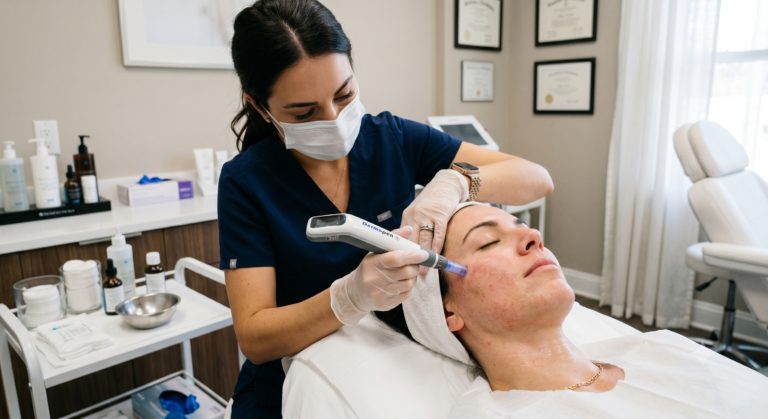
How often should you do microneedling to maintain your results?
Once your initial series is complete, the goal shifts from building collagen to keeping it. For most people, that means one maintenance session every three to six months. Patients focused on glow and texture often prefer a quarterly rhythm, while those who completed a series for acne scars may only need a session once or twice a year to keep the surface refined.
Maintenance matters because the forces behind the original concern keep working. Natural collagen production slows year after year once you pass early adulthood, and daily sun exposure breaks down existing collagen faster than the skin can replace it. A well-timed maintenance session gives the dermis a fresh prompt to rebuild before those losses show up in the mirror.
A couple of signs usually mean it is time to book your next appointment:
- Your skin has lost some of its brightness, and makeup is sitting on the surface again instead of blending smoothly.
- Fine lines or enlarged pores that softened after your series are starting to look more defined in photos.
How does microneedling frequency change by skin goal?
Each skin concern follows a slightly different schedule. The table below outlines typical ranges seen in clinical practice, which your provider will adjust after assessing your skin in person.
Skin goal | Initial series | Spacing | Maintenance |
|---|---|---|---|
Brighter, more radiant skin | 3 sessions | Every 4 weeks | Every 3 to 4 months |
Fine lines and early laxity | 3 to 4 sessions | Every 4 to 6 weeks | Every 4 to 6 months |
Enlarged pores and rough texture | 3 to 4 sessions | Every 4 weeks | Every 4 to 6 months |
Acne scars | 4 to 6 sessions or more | Every 4 to 6 weeks | Once or twice a year |
Stretch marks | 4 to 6 sessions | Every 6 weeks | Once or twice a year |
Microneedling with Bio Filler | 3 sessions | Every 4 to 6 weeks | Every 4 to 6 months |
These ranges are starting points. Skin that responds quickly may need fewer sessions, and skin with heavier sun damage or deeper scarring may need more. Your provider will review your progress after each visit and adjust the plan as your skin changes.
What does the research say about repeated microneedling?
Much of what providers know about spacing comes from studies of how skin changes in the months after treatment. A retrospective analysis published in Plastic and Reconstructive Surgery reviewed 480 patients treated with collagen induction for fine wrinkles, lax skin, scarring and stretch marks. Tissue samples taken from 20 of those patients six months after treatment showed a considerable increase in collagen and elastin, along with a 40 percent thickening of the stratum spinosum, a living layer of the epidermis (Plastic and Reconstructive Surgery).
The six-month mark is the detail worth noticing. Those changes were measured long after the redness had faded and the skin looked healed from the outside. Collagen keeps developing well beyond the recovery period, and a maintenance schedule measured in months fits that biology far better than frequent, closely stacked sessions.
Can you do microneedling too often?
Yes, and overtreating usually works against the glow you are after. Microneedling depends on a controlled injury followed by complete healing. When sessions are stacked too closely, the skin spends more of its time inflamed and less of it rebuilding, which can leave it red and reactive for longer than it should be.
The risk is higher for patients with medium and deeper skin tones, where extra irritation can trigger post-inflammatory hyperpigmentation, the darker patches that sometimes follow inflammation. Anyone with an active breakout or skin infection in the treatment area should also wait until it clears. Collagen forms at the pace your body sets, so returning at two weeks instead of four only interrupts the process it is trying to speed up.
What about at-home microneedling rollers? At-home rollers use much shorter needles than a professional device and reach only the outermost layer of skin. Their main effect is on how well skincare products absorb, which is why people tend to use them more often. They are difficult to sterilize at home, and the rolling motion can drag needles through the skin at an angle and cause small tears. If you already use one, mention it at your consultation so your provider can factor it into your schedule and advise whether to pause it between in-office sessions.
What affects how often you need microneedling?
Two patients can start on the same day and end up on different schedules. Several personal factors shape where you land.
Does your age change the schedule?
Younger patients who use microneedling to maintain healthy skin often do well with two sessions a year once their skin is in good shape. Patients in their forties and beyond, whose collagen production has slowed more noticeably, tend to benefit from a longer initial series and a steadier maintenance rhythm.
Does your skin type play a role?
Sensitive skin and medium to deeper skin tones usually do best with conservative needle depths and slightly wider spacing between sessions. Oilier, thicker skin often tolerates treatment well and may respond faster on a standard schedule.
How much does sun exposure matter?
UV light breaks down collagen continuously, so the more unprotected time you spend outdoors, the faster your results fade. Patients who spend long hours outside, whether on the Cumberland River or in the backyard, may need maintenance at the shorter end of the range.
Does needle depth change the spacing?
Deeper treatments for scarring create a stronger healing response and need more recovery time, so they are often spaced six weeks apart. Lighter treatments aimed at glow and texture work closer to the surface and can usually be repeated on a four-week cycle during a series.
Is fall a good time to start a microneedling series? Autumn is one of the most practical times to begin. After a long, bright Tennessee summer, many patients come in with sun-related dullness and uneven tone, and the cooler months bring shorter days and less time outdoors. A series started in September or October can be finished before spring, which gives freshly treated skin a lower-UV stretch of the year to heal and makes a daily SPF habit easier to keep.
Can you combine microneedling with other treatments?
Microneedling pairs well with several treatments, and combining them can change the ideal spacing. Bio Filler in Clarksville, TN uses platelet-rich fibrin prepared from a small sample of your own blood, and when it is applied during microneedling, its growth factors move into the freshly opened channels to support the healing response. Our article on the PRF Biofiller and microneedling synergy effect walks through how the pairing works and why many patients see a stronger glow from the same number of sessions.
For concerns that sit below the skin surface, microneedling often becomes one part of a layered plan. Sofwave skin tightening in Clarksville, TN uses ultrasound energy to firm the deeper layers of the skin, and Dysport in Clarksville, TN relaxes the muscles behind expression lines, an area microneedling does not reach. Your provider will space these treatments so your skin has time to settle between them, often leaving a gap of about two weeks on either side of a microneedling session.
How do you protect your glow between sessions?
What you do at home between appointments has a direct effect on how long your results last. The first week after each session lays the groundwork, and our microneedling aftercare and recovery guide covers the day-by-day details, from gentle cleansing to when you can wear makeup again.
Beyond that first week, two habits carry the most weight:
- Wear a broad-spectrum SPF 30 or higher every day, cloudy days included, since UV exposure is the main force breaking down the collagen your sessions are building.
- Keep a consistent medical-grade skincare routine, reintroducing retinoids and other active ingredients once your provider clears you to restart them.
Patients who stick with both habits often find they can stretch their maintenance visits toward the longer end of the recommended range.
Frequently asked questions about how often to do microneedling
For broader questions about the treatment itself, our microneedling FAQ is a useful companion to the answers below.
Can you do microneedling every two weeks?
Two weeks is generally too soon for professional microneedling. The skin needs about four weeks to complete the early stage of collagen formation, and treating sooner adds irritation without improving results.
How many microneedling sessions do you need to see results?
Many patients notice a brighter tone within a week or two of their first session. Visible changes in texture and fine lines typically build across a series of three to six sessions spaced four to six weeks apart.
Is once a year enough to maintain microneedling results?
Once a year can work for patients who treated acne scars and want to keep the surface refined. For glow and anti-aging goals, a session every three to six months holds results more reliably.
How far ahead of an event should you schedule microneedling?
Plan on at least two weeks. Redness usually settles within a couple of days and light flaking may follow, so a two-week buffer gives your skin time to look its best. For a wedding or another major event, starting a series two to three months ahead allows more than one session to build.
Does microneedling keep working if you do it regularly?
Regular treatment keeps working as long as sessions are properly spaced. Consistent maintenance gives the skin a steady prompt to produce collagen, which is why long-term patients often find their results easier to hold.
Can the neck and chest follow the same schedule as the face?
The neck and chest can usually follow a similar schedule, though the skin there is thinner and your provider may use shallower depths. Many patients add these areas to their facial treatment so their skin tone stays consistent from the jaw down.
A glow that lasts is a glow that is planned
Microneedling rewards patience and a good calendar. A well-spaced first series builds the collagen, and steady maintenance every few months protects it, so the brightness you notice after treatment becomes the way your skin looks most of the time.
At Face Fabulous Med Spa in Clarksville, Tennessee, every microneedling plan starts with a close look at your skin and a schedule matched to your goals, guided by a conservative approach that favors healthy, natural-looking results. If you are ready to build a glow that lasts, schedule a consultation and let our team map out a microneedling plan that fits your skin and your routine.
References
- Aust MC, Fernandes D, Kolokythas P, Kaplan HM, Vogt PM. Percutaneous collagen induction therapy: an alternative treatment for scars, wrinkles, and skin laxity. Plastic and Reconstructive Surgery. 2008;121(4):1421-1429. Available at: https://pubmed.ncbi.nlm.nih.gov/18349665/
- Alster TS, Graham PM. Microneedling: a review and practical guide. Dermatologic Surgery. 2018;44(3):397-404. Available at: https://pubmed.ncbi.nlm.nih.gov/28796657/
- Chu S, Foulad DP, Atanaskova Mesinkovska N. Safety profile for microneedling: a systematic review. Dermatologic Surgery. 2021;47(9):1249-1254. Available at: https://pubmed.ncbi.nlm.nih.gov/34448760/